


Off-Plan Development Verification is one of the most important steps every buyer should complete before paying a deposit, reserving a unit or signing a sale agreement. Off-plan property can be a smart way to buy into Nairobi’s real estate market because it often offers flexible payment plans, early-buyer prices, modern designs and potential capital appreciation before completion. However, it also requires serious caution because the buyer is purchasing a future property, not a finished unit.
A beautiful render, brochure, site board or sales pitch does not automatically prove that a development is legitimate. A project can look attractive online but still have unclear land ownership, missing approvals, weak developer capacity, unrealistic timelines or poor payment safeguards.
At Realty Boris, we advise buyers to verify first and pay later. Whether you are considering an off-plan apartment in Kilimani, Kileleshwa, Westlands, Riverside, Lavington, Parklands, Upper Hill or another Nairobi location, the project must be checked properly before money moves.
This guide explains how to know whether an off-plan development is legitimate and the key checks every buyer should complete before committing.
Off-Plan Development Verification: What Does It Really Mean?

Off-Plan Development Verification means checking whether a project is legally, physically, financially and professionally credible before you buy. It is not enough for a project to have a good location or attractive prices. The buyer must confirm that the land exists, the developer has authority to sell, the approvals are available, the project can be delivered and the payment process is safe.
A legitimate off-plan development should have:
- A known developer
- A real project site
- Clear land ownership
- Mother title documentation
- Official title search
- Approved building plans
- County approval
- NCA registration where applicable
- NEMA approval where applicable
- Written sale agreement
- Clear payment plan
- Official payment account
- Unit allocation details
- Parking allocation details
- Completion timeline
- Handover terms
- Defect liability terms
- Transfer process
At Realty Boris, we advise buyers to avoid treating due diligence as a formality. In off-plan property, documents are your protection because the apartment is not yet complete.
A legitimate development should be able to withstand serious questions.
1. Verify the Developer First
The first step in Off-Plan Development Verification is checking the developer.
A credible developer should be identifiable, reachable and professionally documented. Buyers should know who is behind the project and whether they have the capacity to deliver what they are selling.
Before paying, ask for:
- Developer company name
- Certificate of incorporation
- KRA PIN certificate
- Company profile
- Official office address
- Authorized signatories
- Previous completed projects
- Current active projects
- Contractor details
- Project consultants
- Official payment account
- Official receipts process
At Realty Boris, we advise buyers to take developer track record seriously. A developer who has successfully completed similar projects gives buyers more confidence than one with no visible delivery history.
This does not mean every new developer should be rejected. It means more verification is required. If the developer is new, the buyer should check the land documents, approvals, consultants, funding structure and sale agreement even more carefully.
A serious developer should not become defensive when asked for documents. If a developer avoids basic questions, refuses to share information or pressures you to pay before verification, that is a red flag.
2. Confirm the Physical Site

A legitimate off-plan development should have a real, verifiable project location.
Before buying, confirm:
- Exact location
- Google Maps pin
- Plot number or title number
- Access road
- Surrounding developments
- Site signage
- Construction status
- Site office where applicable
- Security presence
- Project board
- Neighbouring roads and amenities
At Realty Boris, we advise buyers not to depend only on edited videos, renders or social media posts. Visit the site physically where possible. If you are outside Kenya, request a live video tour or send a trusted representative to inspect the site.
A proper site visit should help you confirm that the advertised location matches the real land. It should also help you understand road access, neighbourhood character, construction activity and surrounding property values.
If the sales team cannot show you the exact site, delays sharing the location or gives vague directions, pause.
A legitimate project should be physically traceable.
3. Check the Mother Title

The mother title is one of the most important documents in Off-Plan Development Verification.
For an apartment project, the mother title is the main title under which the development is being built before individual units are transferred or registered.
Before committing, ask:
- Who owns the land?
- Does the developer own the land?
- If not, does the developer have legal authority to build and sell?
- Is there a joint venture agreement?
- Is the title freehold or leasehold?
- Is there a charge, caution or restriction?
- Does the title number match the site?
- Does the land size match the proposed development?
- Does the land use support the project?
At Realty Boris, we advise buyers not to rely only on a copy of the title. A copy can be outdated. Your advocate should verify it through an official search.
Buyers can use official land information services such as Ardhisasa where applicable. They may also refer to the State Department for Lands search certificate page for official search guidance.
A clean mother title gives stronger confidence, but if there is a charge or restriction, it does not always mean the project is fraudulent. It means the buyer’s advocate must understand what the charge or restriction means and how it will be handled before completion.
The land position must be clear before money moves.
4. Conduct an Official Title Search
An official title search helps confirm ownership and registered interests on the land.
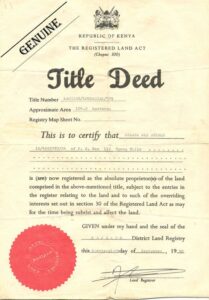
This is one of the most important buyer protection steps because it can reveal issues that may not appear in marketing documents.
An official search may help confirm:
- Registered owner
- Title number
- Land details
- Encumbrances
- Charges
- Cautions
- Restrictions
- Registered interests
- Date of search
At Realty Boris, we advise buyers to insist on an updated search. Do not accept an old search certificate if you are about to make a major payment. Land records can change, so current verification matters.
The search should also be reviewed by your advocate, not only by the seller or agent.
A buyer should ask:
- Is the land registered in the developer’s name?
- Is there a financier involved?
- Is the title charged?
- Are there restrictions on transfer?
- Are there disputes or cautions?
- Does the search match the title copy?
- Does the search match the site?
Off-Plan Development Verification is incomplete without checking the land officially.
5. Confirm County Approvals and Building Permits
A legitimate off-plan development should have proper planning and building approvals from the relevant county authority.
For Nairobi projects, buyers should ask for:
- Approved architectural plans
- County development approval
- Building permit
- Approved number of floors
- Approved unit mix
- Approved parking provision
- Change of user approval where applicable
- Planning conditions where applicable
- Occupation certificate at completion stage
At Realty Boris, we advise buyers to compare what is approved with what is being marketed. If the brochure shows a 20-floor apartment block, the approval documents should support that. If the developer is selling rooftop amenities, basement parking, commercial spaces or specific unit types, buyers should check whether these are reflected in the approved plans.
For Nairobi planning services, buyers can refer to NairobiPlan, which provides access to county physical planning services including building permits and building occupation certificate services. Buyers may also review the Nairobi City County Built Environment and Urban Planning Sector for broader planning context.
A project should not rely on renders alone. Approvals matter.
6. Check NCA and NEMA Compliance Where Applicable
Construction projects may require regulatory compliance beyond county approval.
Depending on the type and scale of the project, buyers should ask whether the development has:
- NCA project registration where applicable
- Registered contractor details
- Contractor licence details
- Architect details
- Structural engineer details
- Quantity surveyor details
- Site supervisor details
- NEMA approval or EIA licence where applicable
- Environmental compliance documentation
- Site safety structure
The National Construction Authority provides guidance on project registration, while the National Environment Management Authority provides information on Environmental Impact Assessment licensing where applicable.
At Realty Boris, we advise buyers not to become technical inspectors themselves. However, buyers should ask whether these documents apply and request them for professional review.
A serious developer should know the compliance status of the project. If the sales team dismisses all compliance questions or says documents are “not necessary,” be careful.
For off-plan developments, regulatory clarity is part of legitimacy.
7. Review the Sale Agreement Before Paying Serious Money
The sale agreement is one of the most important documents in any off-plan purchase.
A legitimate off-plan development should have a clear, professionally prepared agreement that explains the buyer’s rights, the developer’s obligations and the consequences if either party fails to perform.
A strong sale agreement should state:
- Buyer details
- Developer or seller details
- Project details
- Unit number
- Floor level
- Unit size
- Purchase price
- Deposit amount
- Payment schedule
- Completion date
- Delay clauses
- Refund terms
- Default clauses
- Finishing specifications
- Parking allocation
- Amenities included
- Service charge structure
- Handover terms
- Defect liability period
- Transfer process
- Dispute resolution process
At Realty Boris, we advise buyers not to sign an agreement they do not understand. A qualified advocate should review the agreement before signing or paying a substantial amount.
A brochure promise is not enough. If the developer promises a heated pool, gym, borehole, backup generator, rooftop lounge, business centre or parking bay, those promises should be reflected in the documentation.
Verbal promises are weak. Written terms are stronger.
8. Confirm Unit Allocation, Parking and Amenities
A legitimate project should clearly identify what the buyer is purchasing.
Before paying, request:
- Unit allocation letter
- Unit number
- Floor level
- Unit size
- Floor plan
- Balcony details
- Parking bay allocation
- Store allocation where applicable
- Amenities list
- Finishing schedule
- Handover specification
- Service charge estimate
At Realty Boris, we advise buyers to avoid vague unit allocation. If you are buying Unit B1203, the agreement, allocation letter, payment receipt and payment reference should match that unit.
Parking is especially important in Nairobi. A developer may say parking is available, but buyers should confirm whether parking is included, allocated, shared, charged separately or limited.
Amenities should also be clarified. A project may advertise a gym, pool, rooftop lounge, children’s play area, borehole, generator, high-speed lifts and reception, but the buyer should confirm which amenities are included in the approved plans, sale agreement or management documents.
A legitimate off-plan development should make the buyer’s unit clear.
9. Verify the Payment Structure and Official Account
Payment safety is a major part of Off-Plan Development Verification.
Before sending money, confirm:
- Official account name
- Account number
- Whether the account belongs to the developer, seller or advocate
- Whether funds are paid into a client account
- Deposit amount
- Instalment schedule
- Payment reference
- Receipt process
- Refund terms
- Penalties for late payment
- Balance on completion
- Currency guidance for diaspora buyers
At Realty Boris, we strongly advise buyers to avoid sending money to unrelated personal accounts. Every payment should be traceable, receipted and connected to the sale agreement.
For diaspora buyers, this is especially important. Do not send money because someone on WhatsApp creates urgency. Verify the account, agreement and documents first.
A legitimate developer should issue formal receipts and maintain clear payment records.
If account details keep changing or the payment process feels informal, pause and verify.
Off-Plan Development Verification for Sectional Property
For apartment projects, buyers should also understand sectional property documentation.
The Sectional Properties Act provides legal context on units, common property, sectional plans, proposed sectional plans, purchase agreements, by-laws and management structures.
Before buying, ask whether the developer has or will provide:
- Sectional plan
- Proposed sectional plan
- By-laws or proposed by-laws
- Management agreement where applicable
- Recreational agreement where applicable
- Lease or title of the parcel
- Certificate of title or certificate of lease where applicable
- Information on charges affecting the title
- Management corporation details where applicable
At Realty Boris, we advise apartment buyers to understand what they will own individually and what will be shared as common property.
Common areas may include parking, lifts, corridors, staircases, rooftop spaces, gyms, pools, gardens, driveways and service areas. These spaces require proper management.
A good apartment project should be clear about ownership, management and service charge obligations.
Off-Plan Development Verification for Diaspora Buyers
Off-Plan Development Verification is even more important for diaspora buyers because distance increases risk.
If you are buying from abroad, request digital copies of the key documents and have them reviewed by an advocate before payment.
Diaspora buyers should request:
- Developer company documents
- Mother title
- Official title search
- Approved plans
- Sale agreement
- Unit allocation letter
- Floor plan
- Parking allocation
- Payment schedule
- Official bank details
- Receipts
- Construction updates
- Completion timeline
- Handover terms
- Property management plan
At Realty Boris, we advise diaspora buyers not to rely only on relatives, social media, videos or verbal assurances. A trusted relative can help with site visits, but legal verification should be handled by a qualified advocate.
A diaspora buyer should also request regular construction updates during the payment period. These may include site photos, videos, milestone updates and written progress reports.
Buying from abroad can be safe when the process is structured and documented.
Off-Plan Development Verification for Investors
Investors should not only ask whether a project is legitimate. They should also ask whether it is profitable.
A project may be legally sound but still overpriced or unsuitable for rental income.
Investors should check:
- Purchase price
- Price per square metre
- Expected rent
- Service charge estimate
- Nearby apartment supply
- Target tenant profile
- Furnishing potential
- Short-stay rental restrictions
- Building management
- Completion timeline
- Resale value
- Developer reputation
- Vacancy risk
At Realty Boris, we advise investors to avoid buying only because the payment plan is flexible.
A flexible payment plan is useful, but the investment must still make sense after completion. If the rent projections are exaggerated or the purchase price is too high, the investor may struggle to achieve strong returns.
A good off-plan investment should be safe, fairly priced and supported by real tenant demand.
Red Flags That an Off-Plan Development May Not Be Legitimate
Buyers should be cautious if they notice:
- Developer refuses to share documents
- No clear project location
- No mother title information
- No updated official search
- Approved plans are unavailable
- Project details keep changing
- Sale agreement is vague
- Payment requested to unrelated personal accounts
- No formal receipts
- No clear completion date
- No delay or refund clauses
- Parking allocation is unclear
At Realty Boris, our advice is simple: if the documents are unclear, pause.
A genuine project should not fear verification.
Do not allow urgency, discounts or pressure to replace due diligence.
Questions to Ask Before Reserving an Off-Plan Unit
Before reserving a unit, ask:
- Who is the developer?
- What projects has the developer completed?
- Where exactly is the site?
- Who owns the land?
- Is the mother title available?
- Has an official search been conducted?
- Are approved plans available?
- Is the project registered where applicable?
- What is the construction stage?
- What is the completion date?
- What happens if completion delays?
- What is the payment plan?
- Which account receives payments?
At Realty Boris, we advise buyers to ask these questions before paying even a reservation fee.
A reservation can create emotional pressure to continue, even when documents later appear weak. Ask first. Pay later.
Common Mistakes Buyers Should Avoid
When handling Off-Plan Development Verification, buyers should avoid these mistakes:
- Paying before seeing documents
- Trusting renders more than approvals
- Ignoring the mother title
- Not conducting an official search
- Not verifying the developer
- Signing without advocate review
- Accepting vague unit allocation
- Not confirming parking
- Ignoring service charge
- Forgetting completion costs
- Sending money to personal accounts
- Not keeping receipts
- Not checking construction progress
- Assuming all off-plan projects appreciate
- Buying under pressure
- Ignoring nearby supply
- Overestimating rental income
At Realty Boris, we advise buyers to slow down and verify.
Off-plan property can be rewarding when the developer is credible, the price is fair and the documentation is clear.
A disciplined buyer reduces risk before it becomes expensive.
Realty Boris Expert View on Off-Plan Development Verification
Our view is that Off-Plan Development Verification should be done before any buyer sends serious money.
For legal safety, check the mother title, official search, seller authority, sale agreement and transfer path.
For project safety, check county approvals, NCA registration where applicable, NEMA approval where applicable, construction progress, contractor details and consultant information.
For financial safety, check pricing, payment plan, refund terms, delay clauses, service charge and total ownership cost.
For investment performance, check rental demand, resale value, location strength, apartment supply and tenant profile.
For diaspora buyers, insist on digital document review, advocate verification, virtual site inspection, traceable payments and regular updates.
At Realty Boris, we help buyers compare off-plan developments based on verified listings, developer credibility, documentation, project location, payment structure and long-term value.
A legitimate off-plan development should be clear, verifiable and professionally structured.
Final Thoughts
Off-Plan Development Verification is essential before buying any off-plan apartment or development in Nairobi. A project may look beautiful, but buyers must confirm the developer, land ownership, title status, approvals, construction compliance, sale agreement, unit allocation, payment account and completion terms.
Off-plan property can be a strong investment when the project is properly verified. It can offer flexible payments, modern units and potential value growth before completion. However, it can also become risky when buyers rely only on brochures, social media adverts, discounts or verbal promises.
At Realty Boris, we advise buyers to verify first and pay later. A genuine developer should provide documents, allow advocate review and explain the project clearly.
The best off-plan investment is not the one with the loudest marketing. It is the one with strong documentation, credible delivery and realistic market value.
Call to Action
Thinking of buying an off-plan apartment in Nairobi?
Contact Realty Boris for verified listings, developer checks and expert guidance before you reserve, sign or pay.