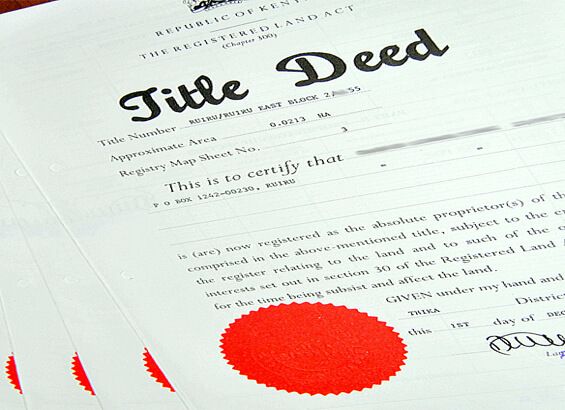
Kenya Land Digitisation Project: 7 Powerful Benefits for Faster Property Transfers

Kenya land digitisation project HOFLASI could become one of the most important reforms affecting property buyers, sellers, developers, advocates, surveyors and lenders over the next five years.
Anyone who has been involved in a Kenyan property transaction understands how much depends on land records.
Before purchasing property, buyers may need to establish:
- Who owns the property
- Whether a title is genuine
- Whether the land is charged to a bank
- Whether cautions or restrictions exist
- Whether boundaries are correct
- Whether the seller has authority to transfer the property
When those records are fragmented, paper-based, difficult to retrieve or inconsistent between registries and survey records, even a straightforward property transaction can become complicated.
That is the problem the Government is now trying to address.
On 16 November 2026, the State Department for Lands and Physical Planning formally launched implementation of the Housing Finance, Lands and Sustainable Investments Project—HOFLASI.
According to the State Department for Lands, the five-year programme is intended to modernise land administration through:
- Digitisation of spatial records
- Digitisation of non-spatial land records
- Modernisation of land registries
- Improved survey infrastructure
- Enhancement of ArdhiSasa
- Better ICT infrastructure
- Stronger data security
- A more reliable geodetic reference framework
- Modernisation of land policies and laws
The World Bank describes the land-administration component as an effort to make property registration faster, cheaper and more reliable, including through end-to-end digital transactions, digitised titles and survey plans, simplified processes, automatic data checks and electronic signatures.
That sounds promising.
But it is important not to jump ahead.
HOFLASI has only just entered implementation.
It would therefore be premature to say:
“Property transfers in Kenya are now faster.”
The better question is:
Could this Kenya land digitisation project finally create the systems needed to make searches, surveys and transfers faster and more secure?
Here are seven ways it could.
1. Kenya Land Digitisation Project Could Make Official Searches Faster
One of the first steps in property due diligence is an official land search.
The State Department for Lands says an official search certificate verifies the ownership status of a property and can identify registered interests such as:
- Charges
- Cautions
- Restrictions
This information is critical.
Imagine buying an apartment, house or parcel of land for KSh 20 million.
Before paying, you need to know whether:
- The seller actually owns it
- A bank already has a charge over it
- Another party has lodged a caution
- Restrictions affect dealings with the property
When records depend heavily on physical registry files, retrieving and verifying this information can become slower.
The Kenya land digitisation project aims to digitise the underlying records and improve the systems through which they are accessed.
If properly implemented, that could mean a future search relies less on someone physically locating a file and more on verified information stored within an integrated digital registry.
That could improve:
- Search turnaround
- Consistency
- Accessibility
- Due diligence
For buyers, this may eventually make one of the first stages of a transaction significantly easier.
But the official search will remain important.
Digitisation should improve due diligence—not eliminate it.
2. HOFLASI Could Reduce Dependence on Physical Registry Files
Kenya’s land-registration history stretches across many decades.
That means a significant amount of ownership information has historically been stored in physical records.
Paper systems create obvious challenges.
Files can be:
- Difficult to retrieve
- Misfiled
- Damaged
- Incomplete
- Stored separately from related survey information
HOFLASI aims to digitise both spatial and non-spatial records.
That distinction is particularly important.
Non-Spatial Records
These can include information relating to:
- Ownership
- Titles
- Deeds
- Transfers
- Registered interests
Spatial Records
These can include:
- Survey plans
- Parcel locations
- Boundaries
- Mapping information
A reliable digital land system needs both.
Knowing that someone owns a parcel is only part of the picture.
You also need to know:
Where exactly is that parcel?
By linking ownership information with spatial information, HOFLASI could create a more complete land-information system.
3. Kenya Land Digitisation Project Could Improve Survey Verification
Land transactions are not only about titles.
Survey information matters just as much.
The State Department for Lands’ land survey search service provides information including:
- Boundary dimensions
- Beacons
- Survey numbers
- Historical changes in parcel configuration
This can be essential when:
- Buying land
- Subdividing property
- Planning development
- Resolving boundary disputes
Imagine purchasing a plot because the seller shows you four physical beacons.
The title may exist.
But do those beacons actually correspond with the registered parcel?
That is where survey verification matters.
HOFLASI includes development of better survey infrastructure and a more reliable geodetic reference framework.
In practical terms, this means improving the reference system through which land positions and survey information are accurately identified.
Better digital survey information could make it easier to reconcile:
what the title describes
with
what exists on the ground.
For buyers and developers, that could reduce uncertainty around boundaries and parcel identification.
4. HOFLASI Could Eventually Speed Up Property Transfers
This is probably the biggest question for ordinary property buyers:
Could property transfers finally become faster?
Potentially.
The World Bank’s HOFLASI documentation specifically describes improving the efficiency of property registration as one of the project’s objectives.
The land-administration reforms are intended to support end-to-end digital land transactions and simplify processes.
Read the World Bank’s HOFLASI project information.
A property transfer can involve several different steps, potentially including:
- Official search
- Preparation of transfer documents
- Consent where applicable
- Valuation
- Stamp duty
- Execution
- Lodgement
- Registration
- Issuance of updated title documentation
If different parts of that process rely on separate paper files and manual verification, delays can occur.
A well-designed digital system could potentially allow information to move between relevant stages more efficiently.
The existing ArdhiSasa platform already supports services including:
- Property searches
- Property transfers
- Charges
- Restrictions
- Cautions
- Survey and mapping services
HOFLASI is intended to improve the system further.
That could ultimately reduce transaction friction.
But digitalisation cannot remove every cause of delay.
A transfer can still be slowed by:
- Ownership disputes
- Succession disputes
- Incorrect documents
- Outstanding charges
- Missing consents
- Tax issues
- Boundary disputes
Technology can accelerate a clean transaction.
It cannot automatically solve a legally defective transaction.
5. Kenya Land Digitisation Project Could Make Property Fraud Harder

Fraud prevention may become one of the most important benefits.
Land fraud can involve issues such as:
- Forged titles
- Impersonation
- Fraudulent transfers
- Altered documentation
- Multiple sales of the same property
A stronger digital registry could make certain types of fraud more difficult by improving:
- Audit trails
- Record consistency
- Ownership history
- Access controls
- Verification
- System checks
The World Bank’s land-administration design includes improved automatic data checks and greater digital functionality.
The State Department for Lands has also specifically identified stronger data security as an objective of the HOFLASI reforms.
This could make it easier to identify inconsistencies.
For example, a secure integrated system may make it harder for conflicting ownership information to move unnoticed between different stages of a transaction.
But buyers should not interpret digitisation as:
“Land fraud is now impossible.”
It is not.
Digital systems create their own risks, including:
- Stolen credentials
- Identity theft
- Cyberattacks
- Unauthorised system access
The objective therefore needs to be:
secure digital land administration
rather than simply moving documents online.
6. ArdhiSasa Could Become Easier and More Reliable
ArdhiSasa is already the centre of Kenya’s digital land-services strategy.
According to the official ArdhiSasa platform, it allows citizens and professionals to interact with land information and lodge applications across areas including:
- Land registration
- Land administration
- Physical planning
- Survey and mapping
- Valuation
But the Government itself acknowledges that the system still needs improvement.
When HOFLASI implementation was launched, the State Department for Lands identified the need to:
- Simplify ArdhiSasa processes
- Improve accessibility
- Strengthen data security
- Improve user experience
This may be one of the most important parts of the Kenya land digitisation project.
A digital land system is useful only if people can actually use it successfully.
For an advocate trying to register a transfer, a surveyor submitting information or a buyer requesting a search, the practical experience matters more than simply knowing that a platform exists.
If HOFLASI successfully simplifies those workflows, digital land transactions could become substantially more predictable.
7. Better Digital Records Could Improve Property Due Diligence

A major property purchase is fundamentally an information problem.
The buyer needs reliable information before making a financial commitment.
That may include:
- Who owns the property?
- What encumbrances exist?
- Where are the boundaries?
- Has the land changed through subdivision?
- What previous transactions have occurred?
The Kenya land digitisation project could improve how quickly professionals obtain and reconcile this information.
This may be especially important for:
- Diaspora buyers
- Mortgage lenders
- Developers
- Institutional investors
Consider a Kenyan living in London who wants to buy an apartment or land in Nairobi.
They cannot physically visit Ardhi House every time a question arises.
A stronger digital land system could allow their independent advocate and other professionals to perform more official verification electronically.
That could make remote property transactions:
- Easier to coordinate
- More transparent
- Faster
But diaspora buyers should still never rely solely on screenshots sent by:
- Agents
- Relatives
- Sellers
- Developers
Official verification remains essential.
What Exactly Is HOFLASI?
HOFLASI stands for:
Housing Finance, Lands and Sustainable Investments.
This is important because HOFLASI is broader than land digitisation alone.
The World Bank-backed programme also includes work relating to:
- Housing finance
- Sustainable financing
- Land administration reform
The project is formally identified as P513352.
The land component is specifically intended to improve property registration and support a better-functioning property and mortgage market.
The World Bank says this component includes three major areas:
Legal and Regulatory Reform
Supporting laws and regulations needed for end-to-end digital land transactions.
Digitisation of Land and Spatial Records
Digitising ownership data such as titles and transfer documents together with graphical survey data.
ArdhiSasa Improvements
Simplifying business processes and adding features such as:
- Automated checks
- Electronic signatures
- Better system functionality
That is much broader than simply scanning paper titles.
What Is Happening Right Now?
As of November 2026, HOFLASI is at an early implementation stage.
The State Department for Lands launched the first field exercise on 16 November 2026.
Teams are conducting needs assessments at:
18 land registries across eight counties.
The counties include:
- Nairobi
- Kiambu
- Machakos
- Kajiado
- Baringo
- Isiolo
- Marsabit
- Mombasa
The exercise is scheduled to run from 16 November to 27 November 2026.
According to the State Department, particular attention is being given to registries handling high volumes of land transactions.
That means it would be inaccurate to say:
“HOFLASI has already digitised 18 registries.”
It has not.
The current exercise is assessing what those registries need so future investments and reforms can be properly targeted.
Why Nairobi, Kiambu and Kajiado Matter
These counties are particularly relevant to the property industry because they contain some of Kenya’s busiest real-estate markets.
Nairobi alone processes transactions involving:
- Apartments
- Houses
- Development land
- Commercial property
- Charges
- Mortgages
- Discharges
- Sectional property
Neighbouring Kiambu and Kajiado have also experienced substantial residential expansion.
Improving land administration in these markets could potentially benefit large numbers of:
- Buyers
- Sellers
- Banks
- Developers
Faster land administration can reduce friction across the entire property market.
Could HOFLASI Help Mortgage Buyers?
Potentially.
Banks need reliable property information because real estate frequently serves as security for loans.
Before financing a purchase, a bank may need to verify:
- Ownership
- Title status
- Existing charges
- Property details
If those records become easier to verify, part of the mortgage process could become more efficient.
This is one reason HOFLASI combines:
housing finance reform
with
land administration reform.
The two are connected.
A bank is more comfortable lending against property where ownership and security interests can be verified reliably.
However, better registration will not automatically make mortgages cheaper.
Mortgage pricing still depends on factors such as:
- Interest rates
- Credit risk
- Funding costs
- Borrower income
Land digitisation tackles the transaction infrastructure, not every mortgage challenge.
Could Property Transfers Become Fully Paperless?
Eventually perhaps—but buyers should not assume this will happen immediately.
Kenya’s registries contain decades of historical property records.
Moving them into a reliable digital environment involves much more than scanning.
Records may need to be:
- Verified
- Indexed
- Reconciled
- Matched to survey data
- Cleaned
- Corrected
Some properties also carry historical disputes.
A computer cannot automatically decide who legally owns land where competing claims are unresolved.
The realistic direction is therefore:
progressively more digital transactions
rather than an overnight disappearance of physical processes.
Could HOFLASI Prevent Double Sales?
It could potentially make some multiple-sale fraud harder.
Imagine a seller trying to represent the same property to several buyers.
A stronger integrated digital registry with better transaction history and restrictions could improve detection and transparency.
But buyers must still protect themselves.
Before purchasing:
- Conduct an official search
- Verify the seller
- Review the title
- Use an independent advocate
- Confirm the property physically
Digital systems make due diligence stronger.
They do not remove the need to perform it.
Could It Reduce Boundary Disputes?
Potentially.
Better digital spatial records and an improved geodetic framework could make parcel identification more reliable.
However, existing boundary disputes may still require:
- Survey work
- Registry review
- Professional determination
- Legal resolution
Digitisation is particularly powerful for preventing future uncertainty where accurate spatial information is captured correctly.
It is less simple where historical records already conflict.
Kenya Land Digitisation Project and Fraud Prevention: What Changes?
The real opportunity lies in creating a better audit trail.
An effective digital land system could record:
- Who submitted an application
- What documents were supplied
- When changes were made
- What approvals were given
This can increase accountability.
It can also make investigations easier when something goes wrong.
But strong cybersecurity becomes essential.
Land records are extremely valuable data.
The stronger the digital system becomes, the more important it is to protect:
- User identities
- Accounts
- Electronic signatures
- Registry access
So fraud prevention must evolve alongside digitisation.
What Could HOFLASI Mean for Developers?
Developers regularly deal with land administration when:
- Acquiring development sites
- Amalgamating land
- Subdividing parcels
- Registering charges
- Discharging financing
- Creating sectional ownership
- Transferring completed units
Delays at any of these stages can affect:
- Project financing
- Handover
- Buyer confidence
A more efficient land-administration system could therefore improve not only individual purchases but also property-development timelines.
For off-plan buyers, that could eventually reduce delays between:
physical completion
and
legal transfer of ownership.
Could It Help Property Investors?
Yes, mainly through better information.
Investors make stronger decisions when they can verify property efficiently.
Improved land records could make it easier to assess:
- Ownership
- Encumbrances
- Survey history
- Transfer status
That can reduce uncertainty.
But investors should remember:
better transaction systems do not make a bad property a good investment.
You still need to evaluate:
- Price
- Location
- Demand
- Rental income
- Legal rights
HOFLASI improves the transaction environment.
It does not guarantee investment returns.
What Challenges Could Slow the Kenya Land Digitisation Project?
The programme is ambitious, and implementation will matter more than announcements.
Several challenges deserve attention.
Historical Records
Some files may be incomplete or inconsistent.
Data Quality
Digitising incorrect information simply creates incorrect digital information.
Survey Reconciliation
Spatial information has to match ownership records.
Legal Disputes
Technology cannot automatically resolve contested ownership.
Cybersecurity
Digital systems require strong protection.
System Reliability
Users need stable platforms and technical support.
Professional Adoption
Advocates, surveyors, registrars and other stakeholders need workflows that actually function in practice.
These challenges explain why the programme is planned over several years rather than several months.
Kenya Land Digitisation Project: What Buyers Should Do Now
HOFLASI does not mean buyers can relax their due diligence.
For now, continue to:
- Conduct an official land search.
- Verify the registered owner.
- Check charges, cautions and restrictions.
- Inspect the physical property.
- Verify boundaries where relevant.
- Confirm survey records.
- Use an independent property advocate.
- Verify payment instructions independently.
- Keep complete transaction records.
The State Department for Lands itself describes an official search certificate as an essential due-diligence document for purchases, leases and financing.
The technology should make these steps easier.
It should not make them optional.
Seven Signs HOFLASI Is Actually Working
Over the coming years, property owners should judge the programme by outcomes.
Watch for:
1. Faster Official Searches
Are verified searches consistently easier to obtain?
2. Faster Transfers
Does clean registration take less time?
3. More Digital Registries
Are more counties integrated?
4. Better Survey Information
Can boundaries and parcel information be reconciled more easily?
5. Improved ArdhiSasa Reliability
Are fewer transactions blocked by system difficulties?
6. Better Transparency
Can parties follow transaction progress more clearly?
7. Better Security
Does the system improve traceability and reduce opportunities for manipulation?
Those are much stronger indicators than simply counting how many documents have been scanned.
Final Thoughts: Could Kenya’s New Land Digitisation Project Finally Make Property Transfers Faster?
Kenya land digitisation project HOFLASI has the potential to significantly improve how property is searched, surveyed, registered and transferred.
Its official objectives directly address many of the weaknesses that have historically slowed property transactions.
The programme is targeting:
- Registry modernisation
- Digitised land records
- Digitised survey records
- Improved ArdhiSasa processes
- Automated data checks
- Electronic transaction capability
- Better survey infrastructure
- Stronger data security
If successfully implemented, the result could be:
faster + more reliable + more transparent property transactions.
But the word could matters.
HOFLASI implementation began only on 16 November 2026.
The first teams are currently assessing registry needs.
So Kenya has not suddenly solved property-transfer delays.
What has changed is that a substantial, multi-year reform programme is now specifically targeting the systems responsible for those delays.
For buyers, that is encouraging.
For developers, it could eventually reduce administrative friction.
For banks, stronger ownership records could improve property verification.
For diaspora investors, more digital land services could make remote purchases easier to manage.
And for the wider property market, a faster land system matters because property is only truly useful as an asset when ownership can be verified and transferred efficiently.
The biggest measure of HOFLASI’s success will therefore not be:
how many records Kenya digitises.
It will be:
whether an ordinary buyer can verify a property, complete due diligence and register legitimate ownership faster and more securely than before.
If HOFLASI achieves that, it could become one of Kenya’s most important property-market reforms in years.
Considering an Off-Plan or Newly Completed Apartment in Nairobi?
Contact Realty Boris to explore carefully selected developments across Westlands, Kilimani, Kileleshwa, Riverside, Lavington and Nairobi’s other premium locations—and carry out proper title searches, survey verification, ownership checks, developer due diligence and independent legal review before committing to a property or making substantial payments.