Introduction
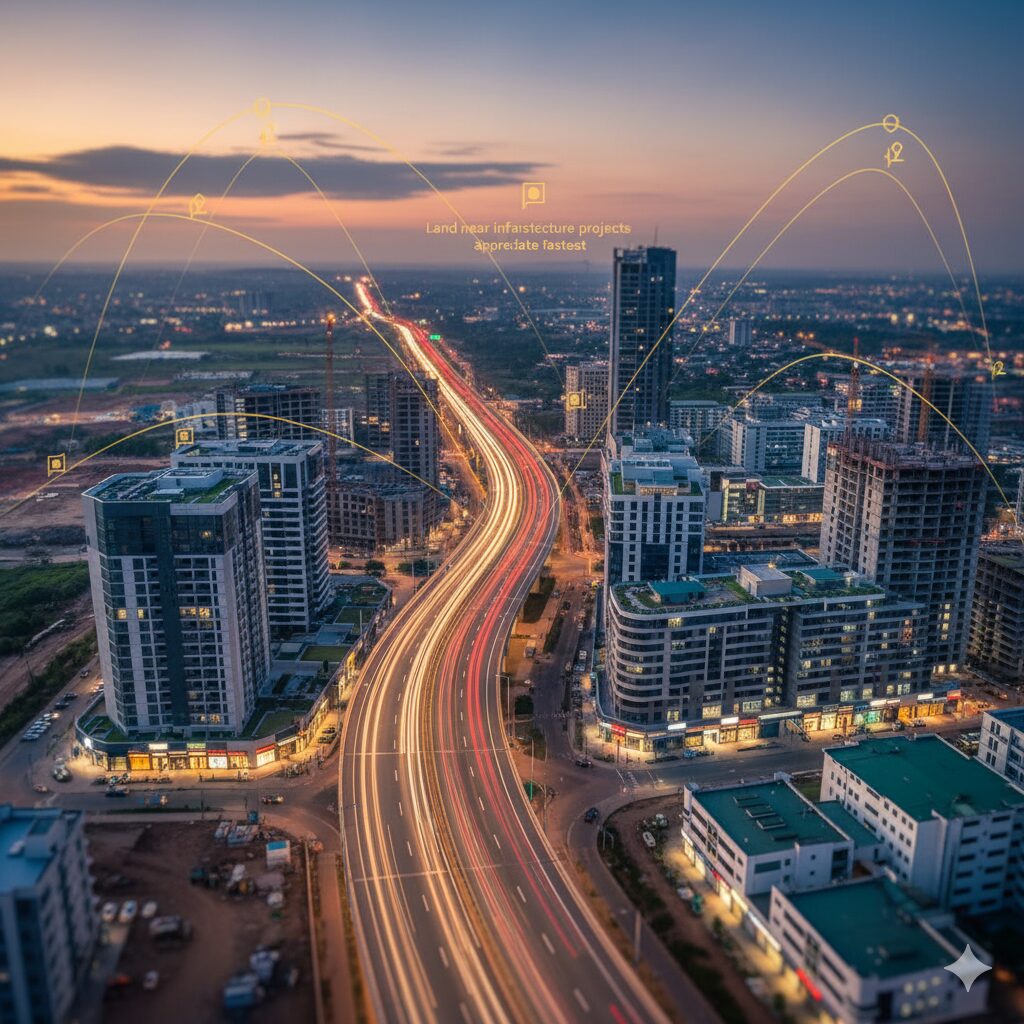
In Nairobi’s fast-evolving real estate landscape, one truth stands out — land near infrastructure projects appreciates fastest. From the Nairobi Expressway to bypasses, rail lines, and new power corridors, infrastructure is now the most reliable catalyst for property value growth.
Whether you’re an investor, developer, or homeowner, proximity to major projects often determines how fast your land appreciates. Roads, bridges, and transit systems don’t just improve accessibility — they transform entire neighborhoods, attract businesses, and trigger residential demand.
Over the past decade, Nairobi’s land values have more than doubled in areas adjacent to key projects such as the Western Bypass, Ngong Road expansion, and the Nairobi Railway City. In this blog, we’ll explore seven powerful reasons why land near infrastructure projects appreciates fastest, supported by data, real-world examples, and investor insights — plus how you can identify the next big growth corridor before everyone else does.
1. Enhanced Accessibility Boosts Land Demand
Infrastructure directly improves accessibility — the foundation of property value. New roads, bypasses, and rail systems cut travel time, connecting once-remote areas to the city’s commercial hubs.
For instance, according to the Kenya Urban Roads Authority – Expressway Impact Report after the completion of the Nairobi Expressway, surrounding zones like Syokimau and Mlolongo recorded up to 35% land price growth within two years. Buyers are drawn by reduced commute times and enhanced mobility, making such locations prime for residential and commercial development.
2. Infrastructure Spurs Commercial and Residential Growth
Where infrastructure goes, development follows. Land near infrastructure projects attracts not only residential investors but also retail, hospitality, and logistics sectors.
Think of Westlands and Upper Hill — both transformed from quiet suburbs into Nairobi’s premier commercial districts once key roads, water, and power upgrades were completed. The pattern repeats in emerging zones like Waiyaki Way and the Southern Bypass, where ongoing projects are sparking mixed-use developments and new residential demand.
The multiplier effect is undeniable: every major infrastructure investment creates layers of opportunity for developers and landowners.
3. Reduced Transport Costs Increase Land Utility
Infrastructure isn’t just about roads — it’s about economic efficiency. Land near infrastructure projects reduces transport and logistical costs for residents and businesses alike.
This cost advantage makes such land more attractive for warehouses, industries, and mixed-use estates. Developers prefer these areas because they lower construction and operational costs while maintaining strong buyer demand.
Over time, this creates a self-reinforcing cycle of appreciation: better infrastructure → more development → higher demand → higher land values.
4. Infrastructure Improves Perceived Safety and Desirability
Areas linked to new or upgraded infrastructure often enjoy improved street lighting, security patrols, and public services — key factors that enhance perception and desirability.
According to the National Land Commission – Infrastructure Development Reports the Eastern Bypass expansion brought enhanced lighting and traffic policing, significantly increasing investor confidence and pushing land prices up by 25% between 2022 and 2024.
When accessibility meets safety, land value rises — and buyers are willing to pay a premium for locations where lifestyle and security coexist.
5. Infrastructure Drives Institutional and Investor Confidence
Banks, developers, and institutional investors closely monitor where government infrastructure money flows. When projects are announced — be it a new bypass or an industrial corridor — financiers view surrounding land as a lower-risk investment.
This investor confidence boosts financing availability for developers, accelerates land sales, and increases price momentum.
A perfect example is Tatu City: once infrastructure like roads, water systems, and fiber connectivity went in, property prices within and around the project zone surged, attracting both local and diaspora investors.
6. Policy Support and Zoning Upgrades Accelerate Appreciation
Government infrastructure projects often come with complementary zoning reforms and policy incentives. These include upgrading agricultural land to mixed-use or commercial use, allowing for higher-value developments.
Such policy alignment ensures that land near infrastructure projects gains not just in accessibility but also in development potential.
The Ministry of Lands – Zoning and Urban Planning has proven that areas like Ruiru, Athi River, and Ruaka all benefited from new zoning guidelines after major road networks were upgraded — directly fueling land price spikes.
7. Infrastructure Creates Long-Term Capital Stability
Unlike speculative trends, infrastructure-induced appreciation is grounded in tangible progress. Roads and transit systems have long lifespans, ensuring steady value growth over time.
Land near infrastructure projects offers sustained appreciation — not just short-term spikes. As more amenities, services, and institutions cluster around these corridors, long-term stability becomes the hallmark of such investments.
For both individual buyers and institutional investors, this makes infrastructure-proximate land the most dependable long-term asset class in Kenya’s real estate ecosystem.
Case Study: The Nairobi Expressway Effect
Since its official launch in 2022, the Nairobi Expressway has dramatically reshaped property values along its route. Neighborhoods like Westlands, South C, and Mlolongo witnessed land appreciation rates between 25% and 40% due to better access and increased investor confidence.
Developers are now racing to build mixed-use towers and serviced apartments within close proximity — capitalizing on accessibility and visibility.
This trend underscores a clear reality: the closer the land is to a major infrastructure project, the faster it appreciates, and the more sustainable that growth becomes.
How to Identify the Next Hotspot
To spot where land will appreciate fastest, investors should monitor:
-
Government project pipelines (roads, rail, energy).
-
Zoning and county development plans.
-
Corporate and institutional expansion.
-
Upcoming public-private partnerships (PPPs).
Savvy investors buy before completion — when prices are still low but infrastructure progress is visible. This early entry strategy consistently delivers higher long-term returns.
Conclusion
Infrastructure remains the heartbeat of Nairobi’s property appreciation story. Land near infrastructure projects continues to outperform other asset types, offering higher returns, stronger investor confidence, and long-term value protection.
Whether it’s the Expressway, bypass networks, or future light rail projects, one principle stands firm: follow the infrastructure, and you’ll find the next wave of property growth.
Call to Action (CTA)
Looking to invest in land near Nairobi’s fast-growing infrastructure zones? 🏗️
👉 Contact Realty Boris today for verified listings, market analysis, and location insights that help you make data-driven property decisions with confidence.